There is one plant about which I’ve receive more emails and questions than any other in the past 38 years. It’s Autumn Blaze maple, and inquiries have far outpaced even questions about the best time to transplant rhubarb.
The questions of course don’t address Autumn Blaze maples that are doing well. They’re about Autumn Blaze that are doing poorly, especially in areas with soils of prairie origin, west of the naturally forested areas of Minnesota. Autumn Blaze and similar maples do beautifully in the forested soils of Minnesota and eastward, but struggle especially in the heavy clay of the Red River Valley and points west.
Autumn Blaze maples have name recognition and have been widely planted with good reason. The fall color is strong and vibrant.
Why does Autumn Blaze have problems in points west of the Minnesota forest tree line?
- Maples easily succumb to iron chlorosis, a yellowing of leaves causes by the tree’s inability to absorb naturally occurring soil iron, especially when maples are out of their preferred soil type. Chelated iron products are available from garden centers, which are a more easily absorbed iron. Sometimes they’re successful, sometimes not. Sometimes ongoing, constant applications are needed.


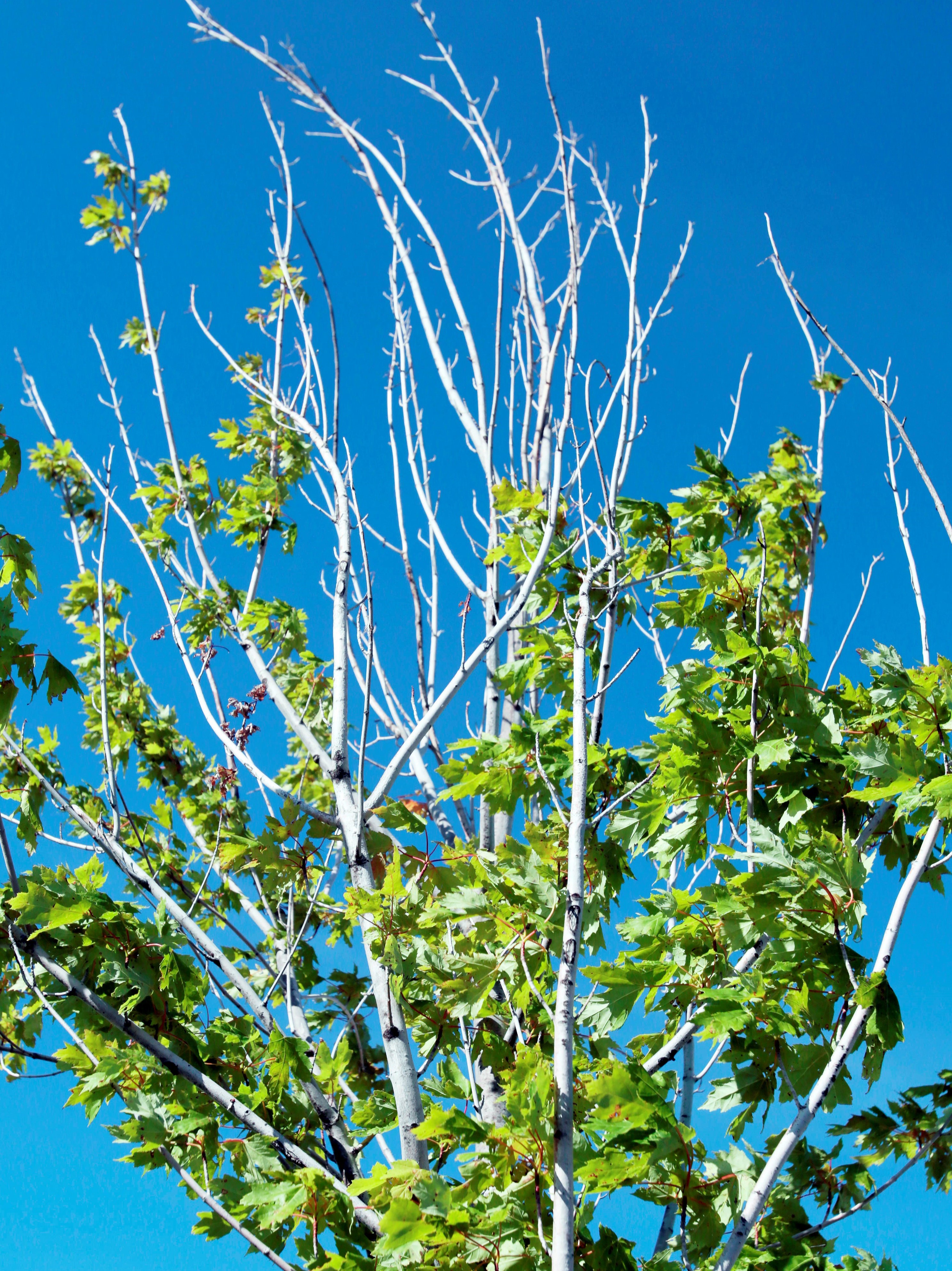
- Even young Autumn Blaze that look beautiful in the fall can suffer major branch dieback in winter. The problem is probably a combination of borderline adaptability, soil incompatibility, winter injury, herbicide sensitivity, planting depth and weather variations and growing conditions causing incomplete fall “hardening off” leading to tender branches being winter-killed.

- Maples as a group are thin-barked, especially when young, making them susceptible to winter bark injury and injury from mowers and trimmers. Tree wraps can help with the winter injury. Mulch around trees to eliminate mower/trimmer damage.
- Sometimes Autumn Blaze can be growing fine for a number of years, and then be hit with dieback.
 Here’s a puzzle: How come one Autumn Blaze maple will be growing beautifully in one yard, and a block away another is dying? This is commonly occurring, sometimes even within the same yard. When homes are constructed, major soil excavation takes place. Topsoil is stripped and piled as is subsoil. When soil is replaced after construction, a tree might end up in a pocket of poor soil. The soil has been greatly shuffled around, excavated and relocated.

So, should Autumn Blaze maple be planted by homeowners? Here’s a suggestion: Autumn Blaze seems to either do beautifully or do poorly – a roll of the dice. In a spot where we would definitely like a newly planted tree to survive, maybe other non-maple choices are better. If we have a secondary spot where we would like to enjoy the glorious colors of Autumn Blaze and are willing to take a chance, then go ahead. If it makes it, great, if not we won’t be crushed. Save Autumn Blaze for special, non-necessary locations.